
Your kitchen trash can size depends on household size and waste habits. A family of four typically needs 12–16 gallons, while smaller households work fine with 7–10 gallons. Before buying, measure your space—most under-sink setups fit 13-gallon cans perfectly. If you compost or recycle heavily, you’ll need less capacity. Matching bag size to can capacity prevents overflow problems. The real approach is balancing your actual trash output with your kitchen’s constraints, which we’ll break down step-by-step ahead.
Start With Room Type and Baseline Capacity
How do you know what size trash can actually fits your life? Understanding your room type and baseline capacity is important for selecting the right receptacle. Your kitchen trash can size depends heavily on household size and waste generation habits. A family of four typically needs a main waste receptacle in the 12–16 gallon range, while larger households might consider 20–30 gallons. Bathrooms require smaller cans around 4 gallons to fit compact spaces. Bedrooms and offices work well with 7–10 gallon trash can capacity. The key is matching your gallon range to both your space constraints and actual trash output. Start by assessing your room type, then choose a baseline capacity that won’t overflow or waste valuable space in your home.
Calculate Household Size to Set Your Target Range
Once you’ve figured out your room type and baseline space, it’s time to focus on what your household actually generates. Your family size directly impacts your main can capacity needs. Two to four people typically do well with 10–16 gallons, while empty-nesters might prefer 7–10 gallons. Got four to six people? A 12–16 gallon can works well between emptying frequency and space considerations. Larger families or multi-person households often need 20–30 gallons to avoid constant trash runs. More occupants mean higher trash output, plain and simple. I know it sounds obvious, but many folks underestimate their household’s waste receptacle needs. Calculate your target range by counting occupants, then match that to your main can capacity. This approach beats guessing every time.
Factor in Composting and Recycling Habits
If you’re diverting food scraps and recyclables away from trash, you’ll need way less capacity than someone tossing everything together. Composting alone can significantly reduce your trash needs, potentially allowing you to downsize your can.
Reducing Trash With Composting
Why does one household need a 13-gallon can while another gets by with just 7?
The answer lies in your composting and recycling habits. When I started composting food waste, my trash volume dropped dramatically. Here’s what changed:
- Food scraps go to compost, not trash – This single shift reduces kitchen waste significantly
- Curbside recycling removes cardboard and containers – Suddenly there’s way more space in my can
- A 7–10 gallon trash can becomes sufficient – No more overflowing bags every few days
- You’ll spend less on trash bags – Smaller cans mean smaller box purchases
Without composting, food waste stays in your trash, pushing recommended sizes toward 12–16 gallons. With it, you’re creating two separate waste streams instead of cramming everything together. Your trash can size directly reflects this choice, making composting an effective strategy for waste management.
Recycling’s Impact On Capacity
How much space you actually need depends on what leaves your kitchen—and what stays. When you’ve got curbside recycling and compost available, you stop stuffing everything into one bin. Separating waste streams shrinks my trash volume. My household trash can sits at a modest 7–10 gallons, handling only true garbage. Without recycling or composting options? That capacity jumps to 20–30 gallons fast. Your main can size really comes down to waste separation habits. If you’re doing curbside recycling but skipping compost, you’ll still cut significantly into household trash. The takeaway: invest in separate bins for each waste type, then downsize your kitchen trash can accordingly. Less frequent emptying follows naturally.
Choose Your Configuration: Under-Sink, Free-Standing, or Pull-Out
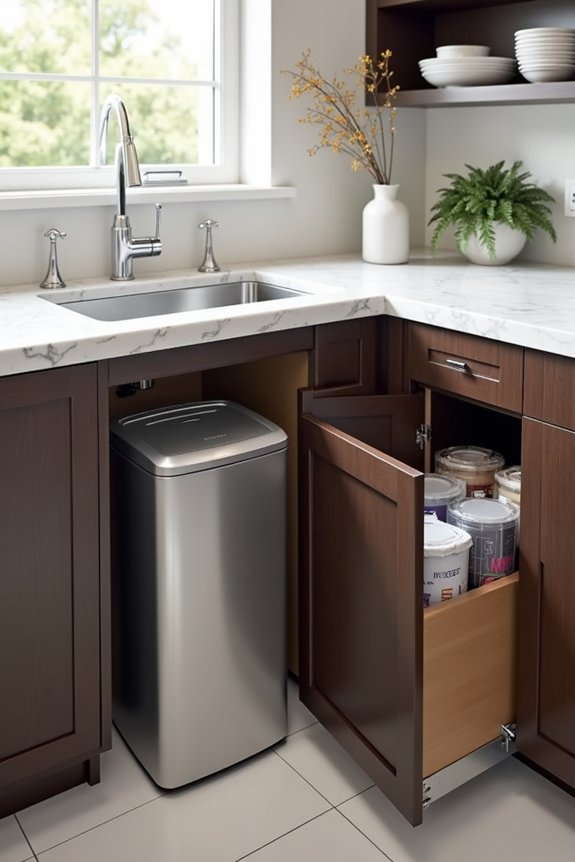
Now that you’ve thought about your waste streams, it’s time to pick where your can actually lives—and your space and daily habits really determine what works best. You’ll want to weigh whether you’d rather tuck a smaller can under the sink to save counter space, go with a free-standing model that’s easy to access, or invest in a pull-out system that keeps things organized but requires some cabinet planning. Each setup has different convenience trade-offs, so let’s figure out which one fits your kitchen and routine.
Space-Saving Installation Options
Where you place your trash can matters just as much as which size you pick. Maximizing your kitchen’s potential means finding the right fit for your actual space.
Consider these space-saving options:
- Under-sink installations work best with cans staying under 10 inches tall to avoid piping conflicts
- Pull-out configurations need bins around 15-inch wide and 20-inch tall to fit standard cabinet bays
- In-cabinet or drawer-style options accommodate 7–10 gallons while maximizing cabinet depth
- Free-standing models suit corners or open areas without installation hassles
Measure your cabinet-height first. Under-sink cabinets typically run 30 inches high, so you’ll want 7–10 gallons maximum there. Pull-out designs offer convenient access while staying hidden. Drawer-style setups work well if you’ve got deeper cabinets. Each option helps you reclaim kitchen real estate while keeping trash organized and accessible.
Accessibility And Placement Trade-Offs
What’s the real difference between tucking your trash away and keeping it within arm’s reach? It’s about your daily workflow. I’ve found that under-sink cans maximize cabinet space but require bending down constantly. Pull-out options offer solid convenience without stealing floor space. Free-standing cans give you accessibility, though they demand more footprint.
| Configuration | Best For | Trade-Off |
|---|---|---|
| Under-Sink | Compact kitchens | Limited accessibility |
| Pull-Out | Balanced needs | Cabinet dimensions matter |
| Free-Standing | High traffic areas | Requires floor space |
Choose placement based on how often you trash stuff during cooking. If you’re constantly tossing scraps, that arm’s-reach convenience matters. But if your kitchen’s tight, under-sink solutions work. Pull-out cabinets split the difference nicely, giving you both accessibility and space efficiency.
Measure Your Space Before You Buy
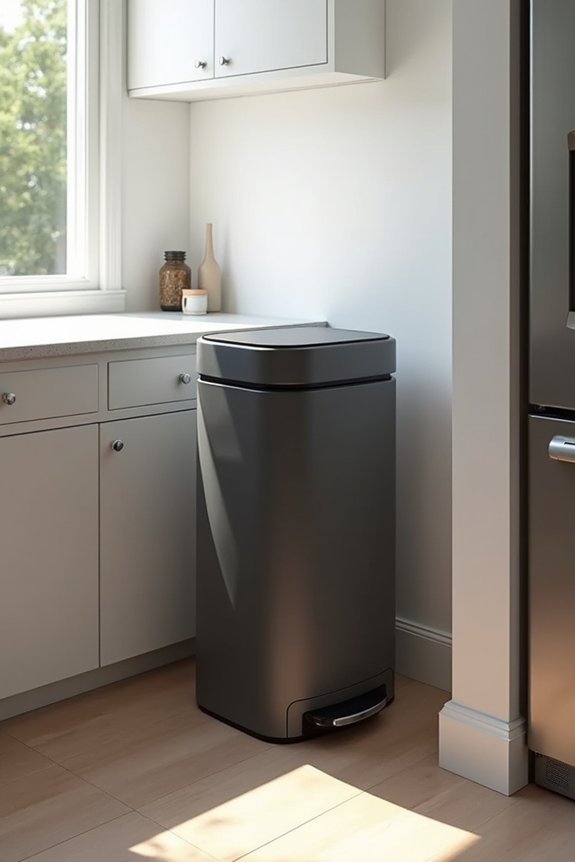
Before you even think about clicking “buy now,” you’ll want to measure where that trash can’s actually going to live.
I learned this the hard way—twice. Here’s what you need to check:
- Width clearance: Measure the space side-to-side; most under-sink areas allow about 10 inches
- Depth clearance: Check front-to-back distance; 18 inches is typical for cabinet footprint planning
- Under-sink height limit: Standard cabinets top out around 30 inches, accounting for pipes and your basin
- Designated zone dimensions: Jot down width, depth, and height of your exact spot
This space measurement prevents ordering a can that won’t squeeze through or blocks cabinet doors. Measure twice, buy once—your future self will appreciate it. A quick tape measure saves frustration and returns later.
The 13-Gallon Standard: Your Safe Bet for Most Homes
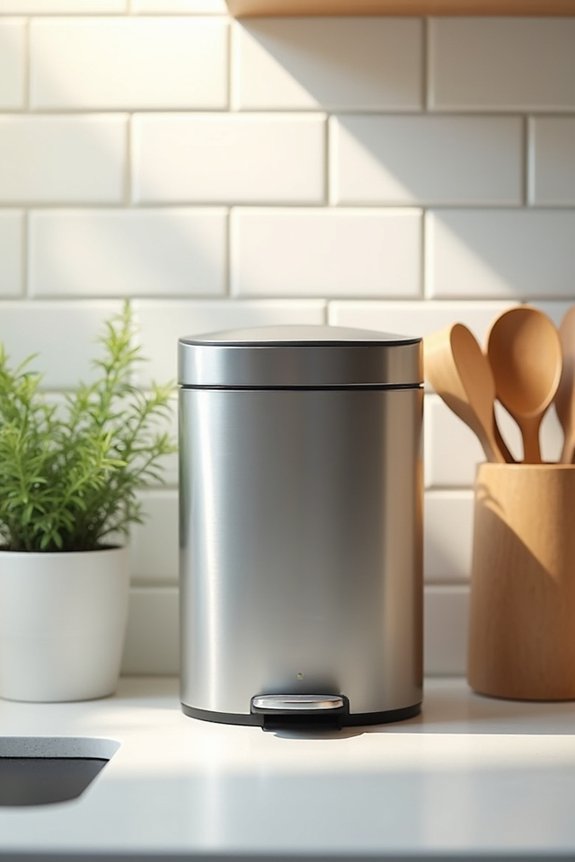
So how do you actually know what size works best? I’d recommend the 13-gallon standard for most homes. It’s the widely accepted kitchen trash can capacity that pairs perfectly with standard 13-gallon bags you’ll find everywhere.
Here’s why it works: a 13–16 gallon size range handles daily waste nicely for families of four or fewer. That’s roughly 45-60 liters of capacity—honestly, it’s plenty for everyday output. The 13-gallon size dominates as the main waste receptacle in kitchens nationwide for good reason.
Unless you’re running a larger household or generating serious waste, you’ll find this option hits the right balance. You won’t be emptying constantly, yet you’re not wrestling with something massive taking up valuable floor space.
Match Bag Size to Trash Can Capacity
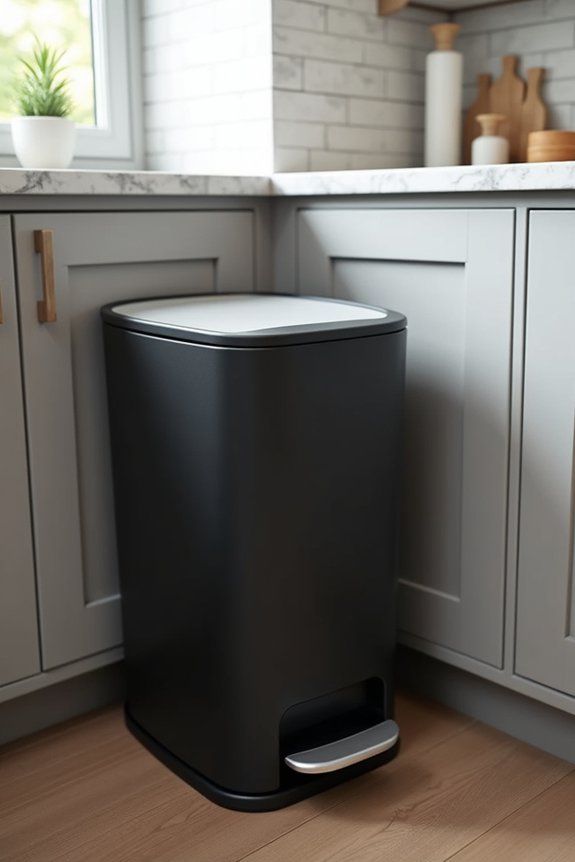
You’ve got to match your bag size to your can size, or you’ll end up with a frustrating mess. I learned this the hard way when I grabbed random bags without checking my can’s capacity.
Here’s what actually works:
- 13-gallon bags fit 13-gallon cans perfectly—this standard pairing makes your life easier
- Under-sink setups need 7–10 gallon bags to fit tight cabinet spaces without overflow
- Large trash cans (20–30 gallons) require bags labeled for that capacity to stay secure
- Check your rim-lock or anchor system since bag compatibility depends on your lid design
The bag-to-can pairing is straightforward when you pay attention. Dual-compartment cans need matching bag sizes for each section. I keep my can’s capacity written inside the cabinet door now, so I grab the right standard trash bags every time. Your future self will thank you.
Should You Go Dual-Bin?
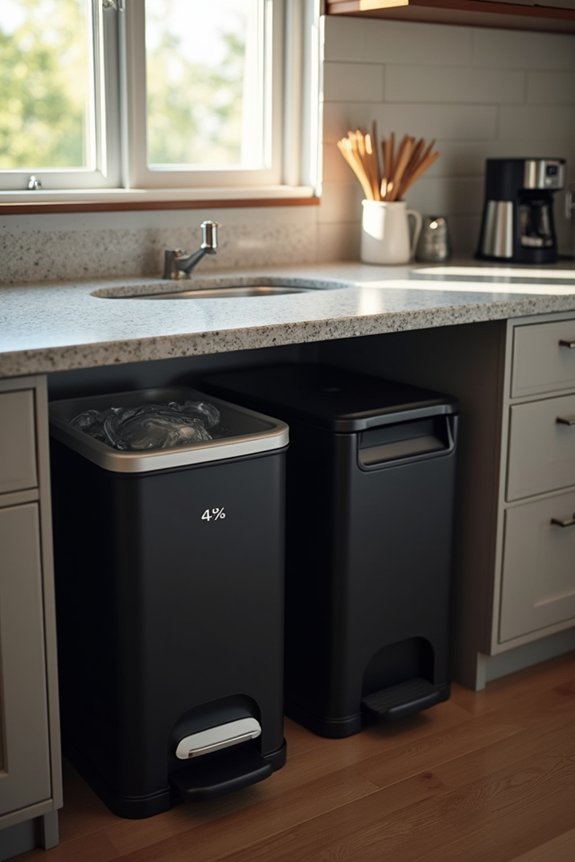
Once you’ve nailed down bag-to-can matching, the next question hits: do you actually need two bins instead of one?
Single 12–16 gallon cans work well for most households. Dual-bin setups have a specific advantage: waste separation. If you’re serious about recycling separation or composting, having two compartments keeps everything organized without taking up twice the floor space.
Single cans suit most homes, but dual-bins excel at organized waste separation and recycling without doubling floor space.
The tradeoffs are real. Dual-bins cost more and require more cabinet space. You’re also managing two inner buckets and lid mechanisms instead of one. Check your footprint carefully before committing.
Dual-bin makes sense if you’ve got dedicated space and handle multiple waste streams regularly. Otherwise, stick with single-bin simplicity and bag compatibility ease.
Best Trash Cans by Household Size
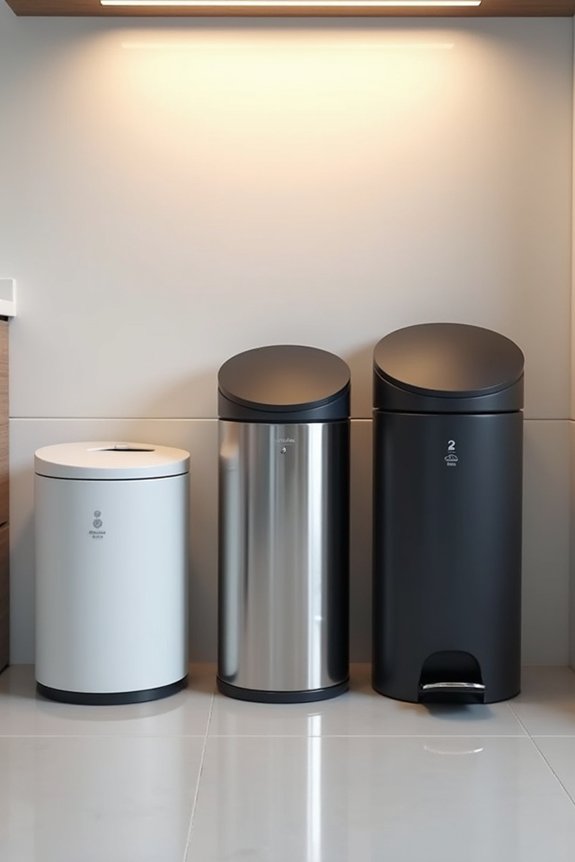
How big should your trash can actually be? I’ve learned that household size really matters here, and I’m sharing what I’ve found works best.
Best trash cans by household size:
- Empty nesters or young couples: 7–10 gallons for your main bin
- Family of four: 12–16 gallons handles daily trash output nicely
- Large families: 20–30 gallons keeps everything contained without constant emptying
- Households with composting and recycling: 7–10 gallons for misc waste works, though 20–30 gallons suits bins handling all streams
Here’s the thing—more occupants mean more trash. I’d rather size up slightly than constantly overstuffing my kitchen trash can. Your household size directly impacts how quickly you’ll fill your best trash cans. Consider your family’s habits too. Do you compost? Recycle actively? Those choices change what your main bin actually needs to hold daily.
Budget-Friendly and Premium Picks
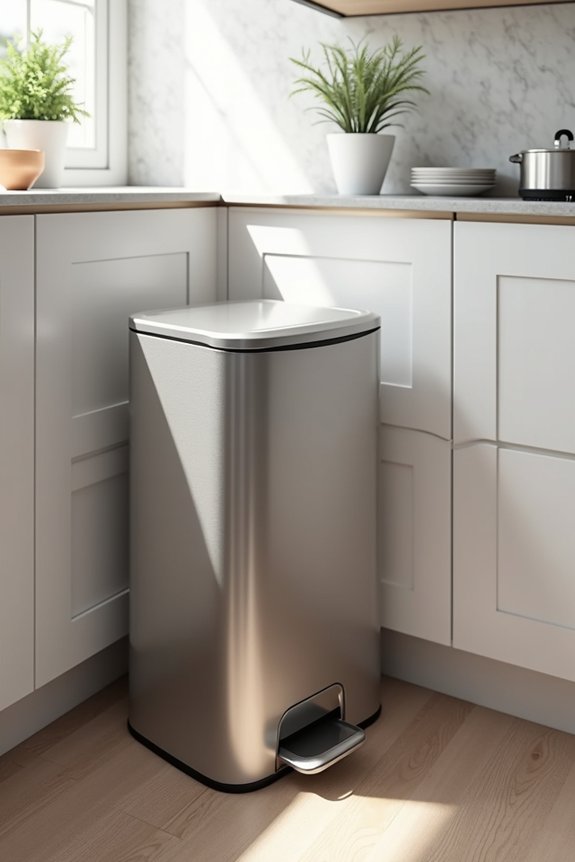
So where’s the sweet spot between price and quality? I’ve found it comes down to what matters most to you.
On the budget-friendly side, the Rubbermaid Step-On delivers solid performance under $30. It holds a 13-gallon bin, features bag security arms, and weighs less than pricier models. It’s honestly perfect if you’re just starting out.
Premium trash cans like Simplehuman offer useful features: removable inner buckets, damper lids, and impressive 10-year warranties. Their under-counter pull-out option glides smoothly for in-cabinet living.
Brabantia’s dual-compartment designs let you sort waste while maintaining that sleek aesthetic. Both premium brands deliver reliable bag compatibility and tight seals.
Your choice depends on budget and lifestyle needs. Budget-friendly works great for basic households. Premium picks justify their cost through durability and thoughtful design features.